Available 24/7 with Emergency Response
Water Damage Restoration in Howe, TX
Wind opens a roof in seconds. The water that follows works for days, and it works out of sight: soaked attic insulation, a wet top plate, a wall cavity that still reads dry from the room. Warrior Restoration takes water calls in Howe around the clock, and we respond within the hour. The damage assessment is free, and so is the written estimate that follows.
Request Help Online
Why Howe Homeowners Choose Warrior Restoration
One Crew Closes the Opening and Rebuilds the Ceiling
Warrior Restoration belongs to Justin Miller, a disabled veteran who owns it outright and works the jobs himself. Six people make up the crew, and they run three response units. On a storm call the unit carries both halves of the first visit: what it takes to board up or tarp an opening, and portable extraction, industrial dehumidifiers, high-velocity air movers, calibrated moisture meters, a thermal imaging camera and a generator. The opening is closed and the drying is running before that unit leaves.
After that it stays one company. The people who cut the wet ceiling out are the ones who hang the new board, float and texture it, paint it and put the trim and flooring back. Warrior Roofing, Justin's roofing company, does the covering over your head; everything under the deck stays here. The job stays in one set of hands from the tarp to the final coat.
What We Do
Our Comprehensive Water Damage Services
A storm loss adds one step at the front of the job and changes nothing after it. Once the opening is shut, water in an attic behaves like water out of a burst supply line, and the rest of the work is our own crew on our own machines.
Emergency Water Extraction
Portable extraction units pull the standing water off flooring, carpet and pad on the first visit. If the ceiling above is still dripping, the opening gets closed before the machines come out, because a floor that keeps being refilled cannot be pulled dry.
Flood Damage Cleanup
A storm can put water into a house from below as well as above. Runoff that has crossed a yard arrives dirty, so the porous material it soaked leaves the house rather than drying in place, HEPA vacuums pick up what the tear-out leaves behind, and antimicrobial goes on the surfaces underneath.
Structural Drying
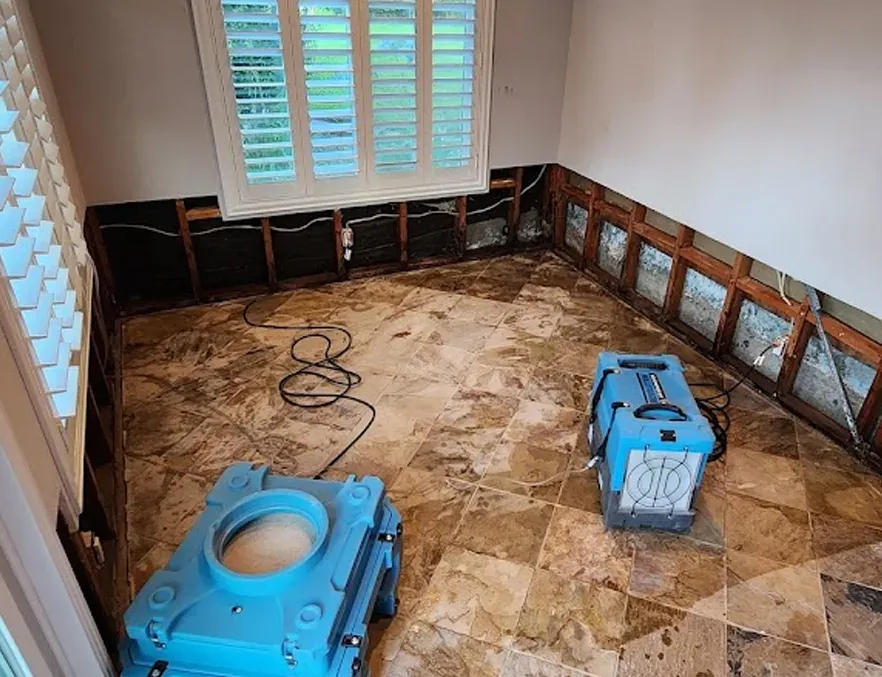
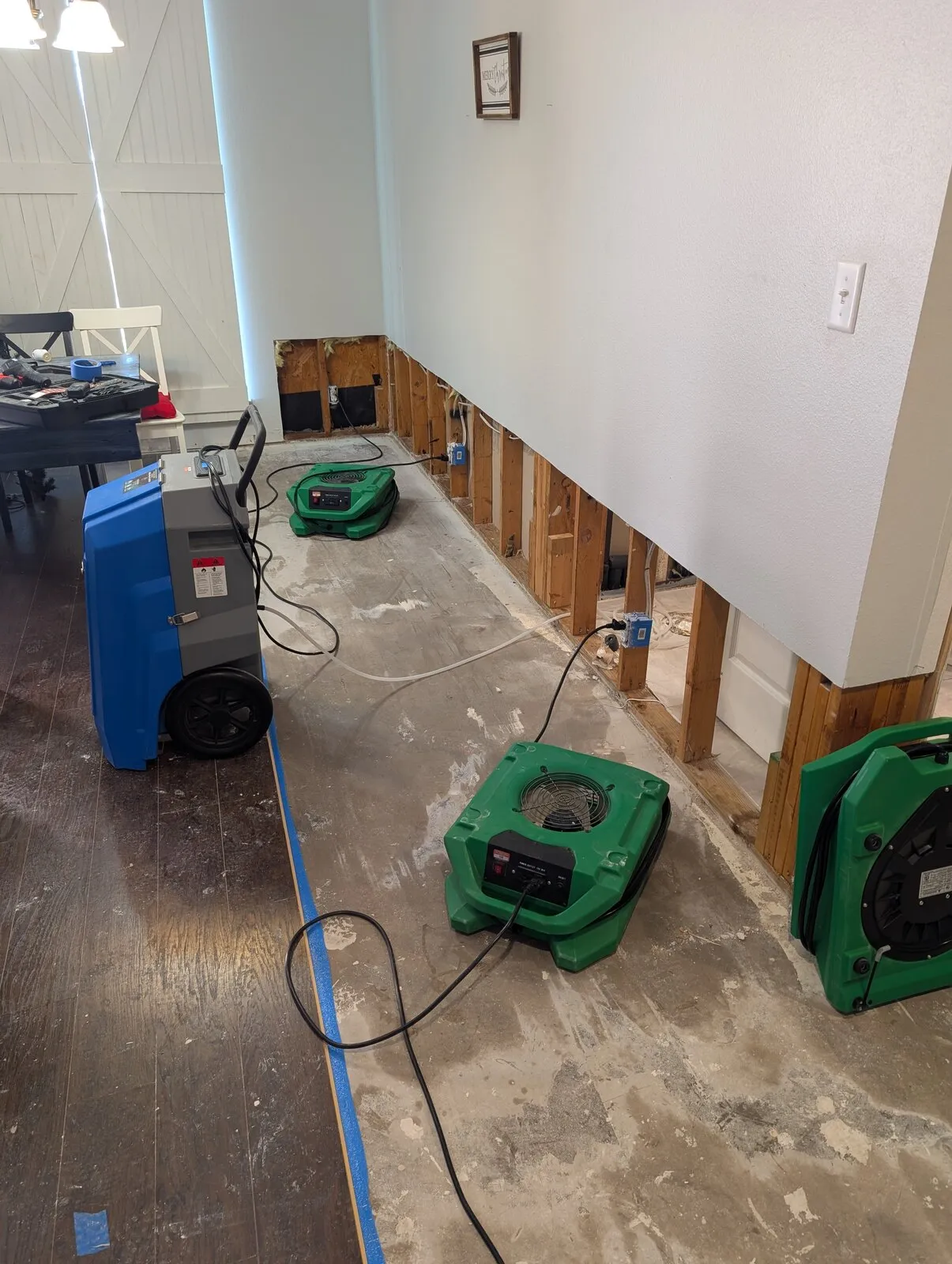
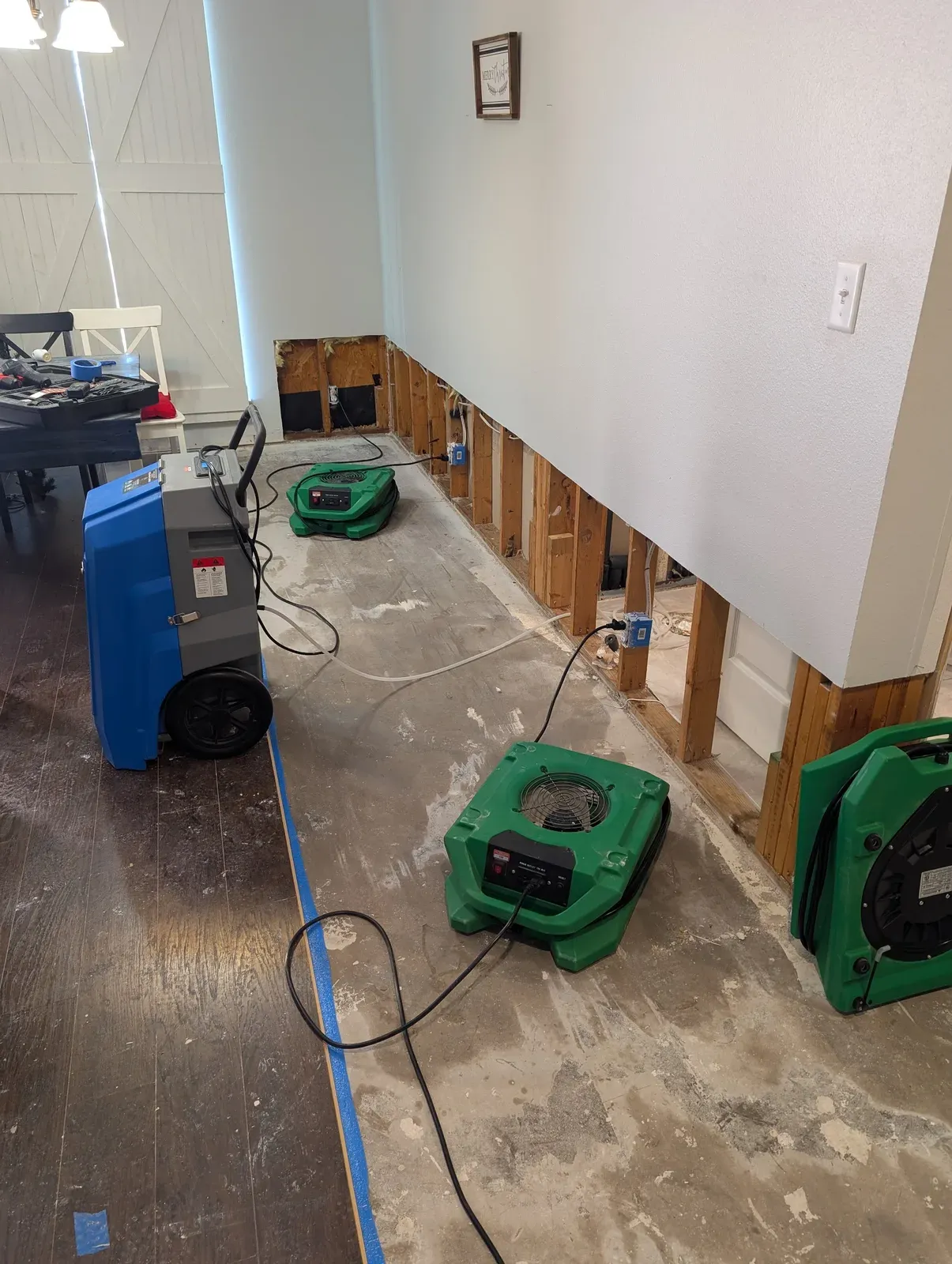
Framing, decking, subfloor and board dry where they stand, under industrial dehumidifiers and high-velocity air movers. An attic that took water through a torn roof holds it in the insulation and the top plate, so the equipment is set for those materials rather than for the room underneath them.
Moisture Mapping
A thermal imaging camera and calibrated meters map the route the water took out of the attic: down one stud bay, along a top plate, into the ceiling of the room below. What that map reads as wet is what comes open.
Wall-Cavity Drying
Injectidry panels push dry air through a wall cavity or under flooring with the finish left on. That keeps the amount of board, texture and paint going back to what the meters actually call wet.
Roof-Leak Water Repair
Emergency tarping and board-up close the opening, and the interior is ours from there: attic insulation, the ceiling assembly, the wall cavity under it, then drywall, texture, trim and paint. The roof covering over it is Warrior Roofing's, the sister company Justin owns.
Mold Prevention
Wet insulation and wet framing are what mold needs, and drying is what takes them away. Equipment stays on until the meters read the material dry, with antimicrobial applied to affected surfaces while it runs. Where growth is already established, the work becomes mold remediation rather than a water scope.
Repairs & Reconstruction
Once the readings hold, the ceiling goes back up: board, tape, float and texture, then trim, paint and the flooring under it. Insulation that came out gets replaced in the same pass, since a dry attic with nothing left in it is half a repair.
How We Work
Inside a Water Damage Restoration Project
Six steps, in the same order every time. On a storm call the first one has a tarp or a board-up going on over your head while it happens.
Emergency Assessment
The first question is what is still letting water in. A storm opening gets closed during this visit with tarping or a board-up. If it is plumbing, closing your main shutoff stops it; the pipe or fixture that let go needs a plumber, not us. A thermal imaging camera and calibrated meters then read the house, and the scope and the written estimate come out of that visit at no charge.
Water Extraction
The standing water comes out with portable extraction units. Carpet pad, wet insulation and anything else holding water where it sits leaves the house on the same visit.
Structural Drying
Dehumidifiers and air movers go in against the moisture map rather than the square footage of the room. Injectidry panels handle the cavities that would otherwise have to be opened, and generators keep it all running where a storm has taken the power out.
Moisture Monitoring
On each return the same materials get read with the same meters. What the meters read is what moves a machine, takes it out, and lets the rebuild start. Attic insulation and a soaked top plate are usually the last to come in.
Repairs Begin
With the readings holding, insulation, board and flooring substrate go back in. Damage the drying turned up after the first approval goes to your carrier as a supplement first.
Final Reconstruction
Texture matched to what is next to it, then paint, trim and flooring. The equipment and the debris leave the house together.
Insurance Claims
We Handle Your Insurance Claim from Start to Finish
A storm loss puts two things in front of your carrier: what the wind or the hail did to the building, and what the water did once it was inside. We document both, price the repair in Estimate Rocket, and send the scope to the carrier ourselves. Warrior Restoration is a restoration contractor, not a public adjuster, and coverage is your carrier's decision.
- We bill your insurance carrier directly. We coordinate with your carrier's adjuster and submit the complete scope of damage.
- We meet adjusters on site. We walk the property with the adjuster so hidden moisture gets documented before approval, not discovered afterward.
- We file supplements. If drying uncovers damage the original approval didn't cover, we file supplements straight with your carrier.
- You never owe us anything beyond the deductible. We accept the carrier's approved amount minus your deductible as payment in full.
- We handle mortgage company checks. If your lender's name is on the insurance check, we coordinate directly with them to get funds released.
Free On-Site Estimates
We inspect at no charge and provide a complete damage assessment before any work begins.
Call (903) 993-5663Workmanship Follow-Through
If our tile or flooring installation causes an issue, we return to fix it.
Water Damage in Howe
What the Storm Opens, the Next Rain Finds
An EF1 tornado crossed Howe on 26 April 2016 with winds of 95 to 100 mph. The National Weather Service recorded roof loss on multiple houses, snapped light poles, and AC units torn loose at Howe High School along with water intrusion into that building. The wind was finished in a minute. The water it let in was not.
Hail does the same job quietly. On 9 May 2024 a storm put baseball-size hail on the town, toppled trees and downed power lines, and the Howe Fire Department reported structure fires out of the same event. Hail that size splits the shingle mat and bruises the deck without leaving anything you can see from the driveway. The roof still looks like a roof. It has only stopped shedding water, and that turns up on the next rain instead of that night.
The gap is where the second loss lives. Rain coming through an opening soaks attic insulation, wets the top plate, runs the wall cavity and reaches the drywall and flooring a floor below. That is why emergency tarping and board-up are water work rather than roof work, and why they go up on the first visit ahead of the extraction. Nothing dries under a hole that is still taking rain, and storms that open roofs here bring power lines down with them, which is what the generators on the truck are for.
The corridor is old and the town is not. An F5 tornado crossed Grayson County on 15 May 1896 and swept away the farms around Howe. No house standing here today dates to it, so it says nothing about anyone's walls and everything about the ground they sit on. What has changed is how many roofs are on that ground: Howe went from 2,600 residents at the 2010 Census to 3,571 at the 2020, Howe ISD ran 1,265 students in 2024-25, and Texas Instruments' semiconductor fab campus in the same county is pulling more of Grayson County's growth this way. Same sky, more roofs under it, and closing the opening in one of them is still the first thing that happens.
Call (903) 993-5663Equipment We Use for Water Jobs
- Portable water extraction units: remove standing water from floors and carpet
- Industrial dehumidifiers and high-velocity air movers: dry structural materials to certified standards
- Injectidry wall-cavity panels: dry behind drywall and under floors in place
- Negative-air machines: control airflow when a water loss needs a drying chamber
- Calibrated moisture meters: verify materials reach certified dry standards
- Thermal imaging cameras: find hidden water inside walls and ceilings
- HEPA vacuums: safe cleanup of debris and contaminated materials
- Generators: maintain power for drying equipment on site
More Restoration Services
We Restore Homes Across Grayson County
Two things worth settling before you call: how far along the water already is, and which address it is at.
Roof Leak Water Damage Repair
If the opening is already shut and what's left is a stained ceiling, flattened insulation and a wall that won't dry, the interior side of a roof leak is the job in front of you.
Learn MoreWater Damage Restoration in Tom Bean
The wet house isn't always the one you're standing in. If the water is at a Tom Bean address, that is the loss that page is written for.
Learn MoreWater Damage Restoration in Anna
Plenty of people here look after a house they don't sleep in: a rental, a parent's place, one that's on the market. If that house is in Anna, the crew, the meters and the drying equipment go to that address.
Learn MoreSTILL GOT QUESTIONS?
Frequently Asked Questions
The questions that come up most on a storm-driven water loss. For anything past them, call (903) 993-5663.
24/7 Emergency Response
Get Immediate Water Damage Restoration in Howe, TX