Available 24/7 with Emergency Response
Water Damage Restoration in Little Elm, TX
Water that crossed a yard and water out of a broken supply line leave a house in two different conditions, and that difference decides what has to come out and what can dry where it is. We take water calls in Little Elm at any hour of the day, and we respond within the hour. The visit and the estimate cost nothing.
Request Help Online
Why Little Elm Homeowners Choose Warrior Restoration
One Company, From the Wet Carpet to the Last Coat of Paint
Six people, three response units, and the owner on the jobs: Justin Miller is a disabled veteran and he runs Warrior Restoration himself. The unit that pulls up carries what a first visit needs before anyone knows which kind of loss it is: portable extraction units, industrial dehumidifiers, high-velocity air movers, calibrated moisture meters, a thermal imaging camera, Injectidry wall-cavity panels, HEPA vacuums and a generator. By the time that unit pulls away, the water is off the floor, the dehumidifiers are running, and we know whether we're drying a clean-water loss or tearing out after dirty water.
The crew that cuts wet material out is the crew that puts it back. Demolition, drywall hang and finish, texture, paint, trim and flooring are all in house, so the rebuild starts when the meters allow it and not when a second contractor has an opening. Your carrier sees one scope with one company's name on it.
What We Do
Our Comprehensive Water Damage Services
The list doesn't change from house to house. Which parts of it your loss needs depends on where the water came from and how long it sat. All of it is our own crew and our own equipment.
Emergency Water Extraction
The free water comes up first, with portable extraction units, and the carpet pad goes out with it once it has soaked through, since a wet pad holds water under the surface where an air mover cannot get at it. Extraction runs out to where the meters stop reading wet, which on an open floor plan is usually rooms past the one it started in.
Flood Damage Cleanup
Water off the ground comes in dirty, and dirty water rules out drying the soft material in place. Tear-out and disposal come first, HEPA vacuums pick up the fine debris, the surfaces underneath are cleaned, and an antimicrobial is applied to what stays.
Structural Drying
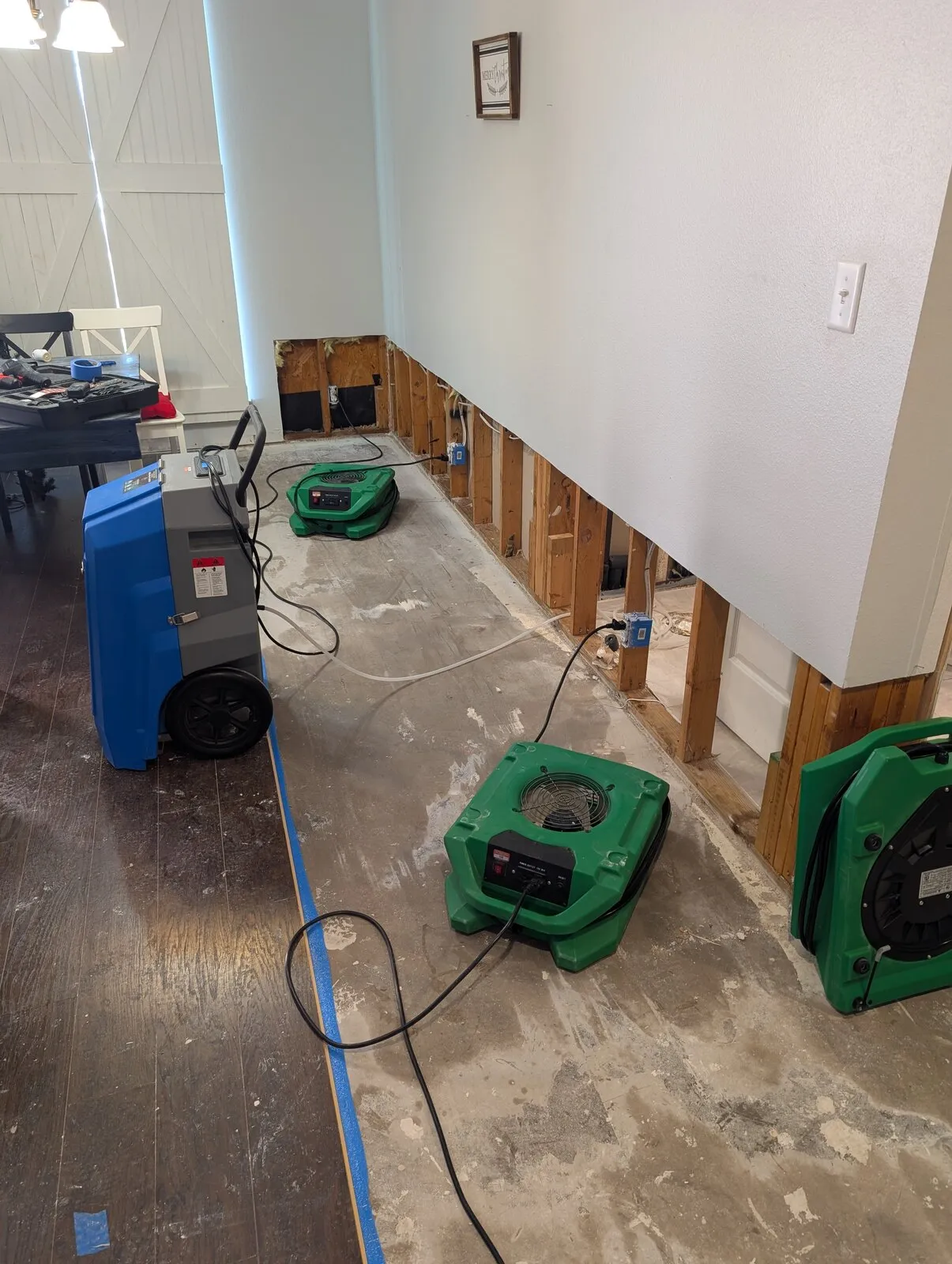
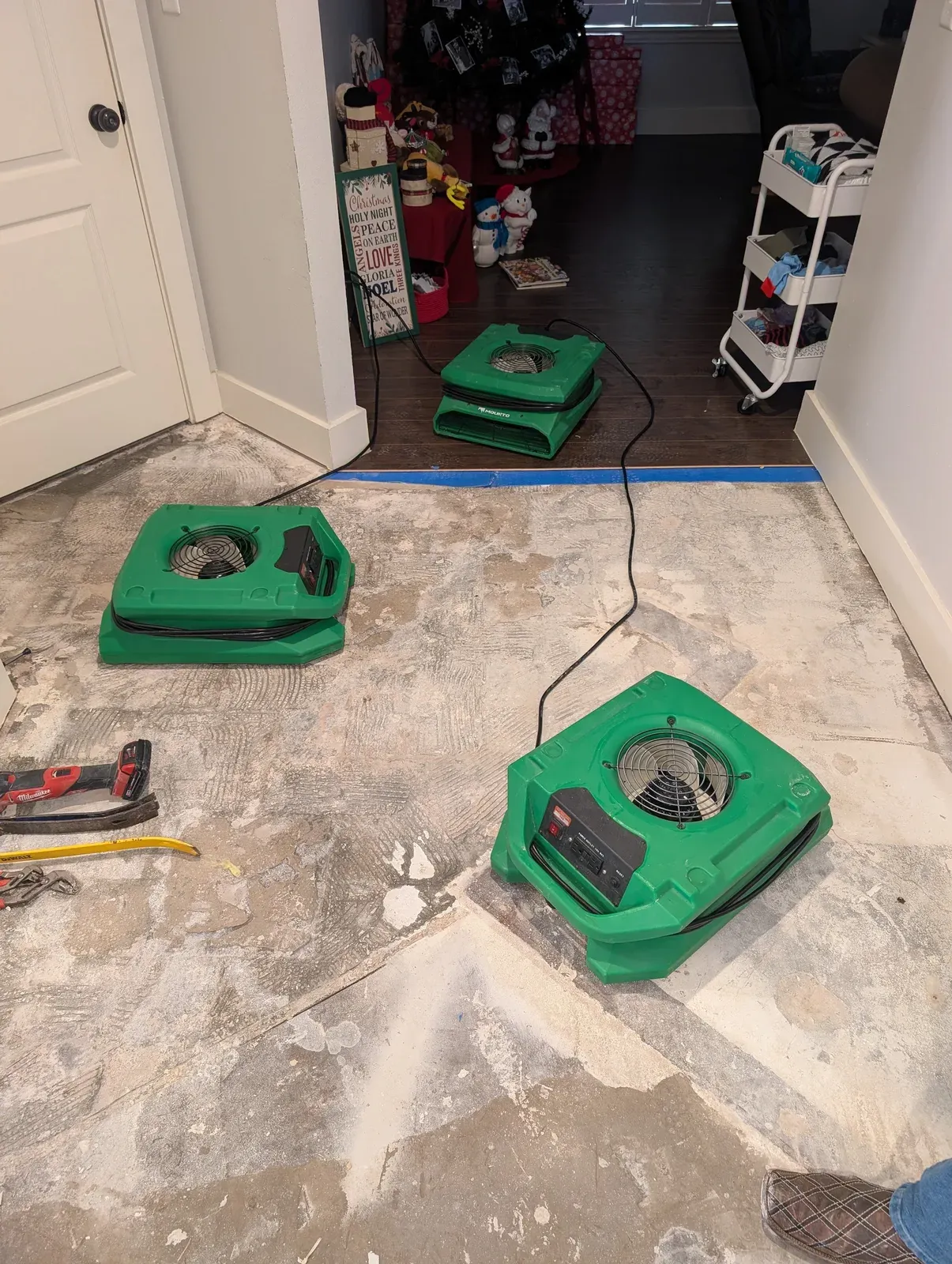
Industrial dehumidifiers and high-velocity air movers work as a pair: the movers lift moisture off surfaces, the dehumidifiers pull it out of the air. Both are sized to the volume of the space and the materials in it, and generators cover a house with the power off.
Moisture Mapping
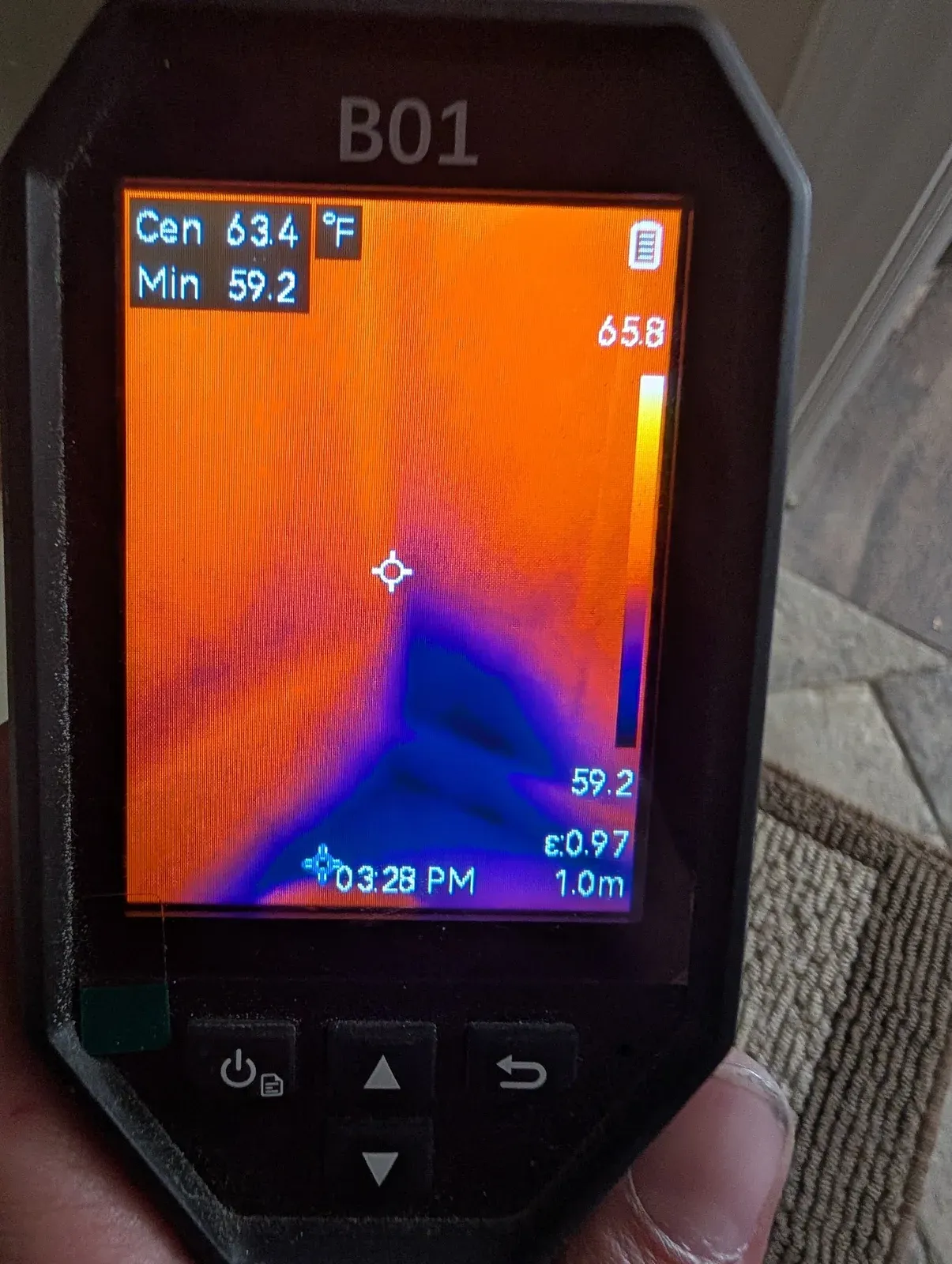
A thermal imaging camera and calibrated meters find the wet edge behind drywall, under flooring and in the bottom plate. Water on a slab travels sideways further than the damp patch suggests, so what comes out follows the map and not the stain.
Wall-Cavity Drying
Injectidry panels feed dry air into a wall or floor cavity through small ports, so framing and insulation dry with the finish left on. On clean water that often saves the drywall. Where the water came in dirty, the cavity is opened instead, because soaked insulation cannot be cleaned in place.
Roof-Leak Water Repair
Board-up and emergency tarping keep the next rain from adding to it. Inside, the wet insulation comes out, the attic and top plates are dried, and the ceiling and drywall are repaired here. The roof covering itself is Warrior Roofing's, the sister company Justin owns.
Mold Prevention
Mold needs material that stays wet and time to work on it. Drying fast and proving it with a meter takes away both, and an antimicrobial goes onto the surfaces that stayed wet longest.
Repairs & Reconstruction
Board goes back up, gets taped and floated, and the texture is matched to the wall beside it. Then paint, trim and floor covering. The rebuild sits under the same scope as the drying, so nothing waits on a second contractor.
How We Work
Inside a Water Damage Restoration Project
The sequence is fixed. How long the middle of it runs is not, and the meters set that, not the calendar.
Emergency Assessment
Before anything else: is water still getting in? If a valve shuts it off, we'll close it; repairing whatever failed is a plumber's job and not ours. Then a thermal imaging camera and calibrated meters go over the house. Where the water came from matters as much as where it went: water that arrived over the ground puts the job on a different track from a supply line that failed inside a wall.
Water Extraction
Standing water comes up with portable extraction units. Anything that won't give the water back where it sits leaves on the same visit: soaked pad, wet insulation, swollen baseboard, and on a dirty-water loss everything porous the water reached.
Structural Drying
Dehumidifiers and air movers go where the airflow does the most good, sized to the wet area instead of the room. Injectidry panels take the cavities that can dry with the finish on. When the power's out, the drying still runs off our generators.
Moisture Monitoring
We come back and read the same points with the same meters. The numbers are what move equipment, take it out, and release the rebuild. Nothing closes up over material that hasn't held a dry reading.
Repairs Begin
Once the readings hold, what came out goes back: insulation, board, flooring substrate. Anything the drying exposed that the first approval didn't cover goes to the carrier as a supplement first.
Final Reconstruction
Paint, trim and the finish flooring go on last. The room goes back to what it was, done by the same crew that opened it.
Insurance Claims
We Handle Your Insurance Claim from Start to Finish
The scope your carrier prices comes from us. We write it in Estimate Rocket, submit it to them directly, and meet the adjuster at the house to walk the loss with them. Where the pricing falls short of what the repair takes, we go back to the adjuster with those items. Coverage itself is your carrier's decision. Warrior Restoration is a restoration contractor, not a public adjuster.
- We bill your insurance carrier directly. We coordinate with your carrier's adjuster and submit the complete scope of damage.
- We meet adjusters on site. We walk the property with the adjuster so hidden moisture gets documented before approval, not discovered afterward.
- We file supplements. If drying uncovers damage the original approval didn't cover, we file supplements straight with your carrier.
- You never owe us anything beyond the deductible. We accept the carrier's approved amount minus your deductible as payment in full.
- We handle mortgage company checks. If your lender's name is on the insurance check, we coordinate directly with them to get funds released.
Free On-Site Estimates
We inspect at no charge and provide a complete damage assessment before any work begins.
Call (903) 993-5663Workmanship Follow-Through
If our tile or flooring installation causes an issue, we return to fix it.
Water Damage in Little Elm
Fifteen Feet of Elevation, and a Yard That Drains Slowly
Lewisville Lake sits at a normal pool level of 522 feet. The elevation its hundred-year flood is figured at is 537 feet. Little Elm is built on four peninsulas inside that lake, which covers 53% of the town, and the ground rises to 596 feet at the highest point but is flat for most of the way there. The flat part is what shows up on a work day: stormwater crosses a residential lot slowly instead of running off it, so it stands against a slab, a threshold and a weep hole.
Where the water had been before it got inside decides the job more than how much of it there is. A supply line that lets go inside a wall puts clean water into materials that can often dry where they sit, with panels feeding the cavity through small ports. Water that crossed a yard or came back up out of a drain arrived carrying soil and whatever the street was holding, and porous material that took that on is pulled and disposed of instead. Long contact time makes that worse, and a lot that drains slowly is a lot that gives water a long contact time.
The margin has been tested. In late May 2015 the lake came up to within about 2.5 feet of the hundred-year elevation, the Army Corps of Engineers closed it to boat traffic, and a lakeside backyard in town went under. The same year the dam developed a sand boil, a seepage problem serious enough to start a $150 million Corps repair and spillway-upgrade project, with the seepage risk-reduction work finished in August 2021. None of that predicts anything about a particular address. It is the reason the first read on a wet floor here asks where the water came from before it asks how far it went.
The town grew from 3,646 residents in 2000 to 54,820 in 2024, and 91.6% of its housing was built in 2000 or later, which puts a lot of original water heaters, supply connectors and PEX runs at the end of their service life at roughly the same time. What is particular to this town, though, is the ground all of it sits on. Fifteen feet is the entire margin between the lake at its ordinary level and the elevation its hundred-year flood is figured at, and the land in between is flat enough that a yard sheds water slowly. So a house in Sunset Pointe or Union Park that takes water from outside gets no help from its own grade, and what the loss costs turns on how long the water stayed in contact with the material rather than on how deep it got.
Call (903) 993-5663Equipment We Use for Water Jobs
- Portable water extraction units: remove standing water from floors and carpet
- Industrial dehumidifiers and high-velocity air movers: dry structural materials to certified standards
- Injectidry wall-cavity panels: dry behind drywall and under floors in place
- Negative-air machines: control airflow when a water loss needs a drying chamber
- Calibrated moisture meters: verify materials reach certified dry standards
- Thermal imaging cameras: find hidden water inside walls and ceilings
- HEPA vacuums: safe cleanup of debris and contaminated materials
- Generators: maintain power for drying equipment on site
More Restoration Services
We Restore Homes Across Denton County
Whether the water came off the ground, who is responsible for the house it's in, and which address the claim is written at each change where to start.
Flood Damage Cleanup
Water that stood on a flat lot before it reached your threshold carries the soil it sat in, and anything porous it soaked gets pulled out instead of dried. If that's your loss, flood damage cleanup is the sequence you're in.
Learn MoreWater Damage Restoration in The Colony
If you're the owner rather than the occupant and the wet house is in The Colony, the address is what we need to start; the authorization to open anything up comes from you.
Learn MoreWater Damage Restoration in Frisco
The address on the claim is the one that decides this, not the one you sleep at. If that's a Frisco address, start there.
Learn MoreSTILL GOT QUESTIONS?
Frequently Asked Questions
Six that come up on most water calls here. For anything not on the list, (903) 993-5663 reaches us at any hour.
24/7 Emergency Response
Get Immediate Water Damage Restoration in Little Elm, TX