Available 24/7 with Emergency Response
Water Damage Restoration in The Colony, TX
Two houses in The Colony can be thirty years apart in what's behind the drywall, and they don't fail the same way. We work water losses here around the clock, and the response comes inside the hour. Neither the assessment nor the estimate we write from it costs anything.
Request Help Online
Why The Colony Homeowners Choose Warrior Restoration
The Whole Job Stays With One Crew
Justin Miller owns the company outright, runs the crew and is a disabled veteran. There are six of us and three response units, and a unit shows up carrying what the whole first visit takes: portable extraction, industrial dehumidifiers, high-velocity air movers, calibrated moisture meters, a thermal imaging camera, Injectidry wall-cavity panels and a generator. That unit doesn't leave with water still standing on your floor, and the drying starts on that visit.
Demolition, drywall, texture, paint, trim and flooring are all ours. The people who cut the wet material out are the ones who put the room back, so the rebuild waits on the readings rather than on another company's calendar. The roof covering itself is Warrior Roofing's work, Justin's other company under the same ownership; everything the water did on the inside stays here.
What We Do
Our Comprehensive Water Damage Services
Nothing on this list is subcontracted. The crew that takes the call does all of it, using gear that comes off our own units. Which parts a house needs depends on where the water started, and that tends to follow the decade the house was built.
Emergency Water Extraction
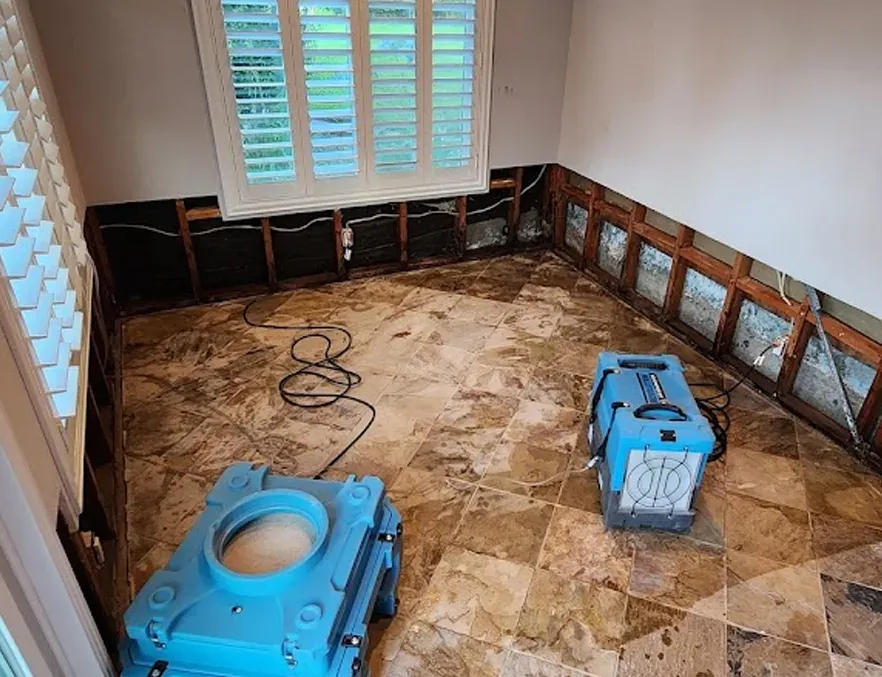
Standing water comes off tile, wood, carpet and the pad beneath it with portable extraction units. Water on a slab sits low and travels flat, so the toe-kicks and the base of the walls get cleared on the first pass rather than a later one.
Flood Damage Cleanup
Water that arrived over the ground or backed up a drain line isn't the same job as a clean supply line. Anything porous that soaked it up leaves the house, HEPA vacuums take the debris, and an antimicrobial goes on what stays.
Structural Drying
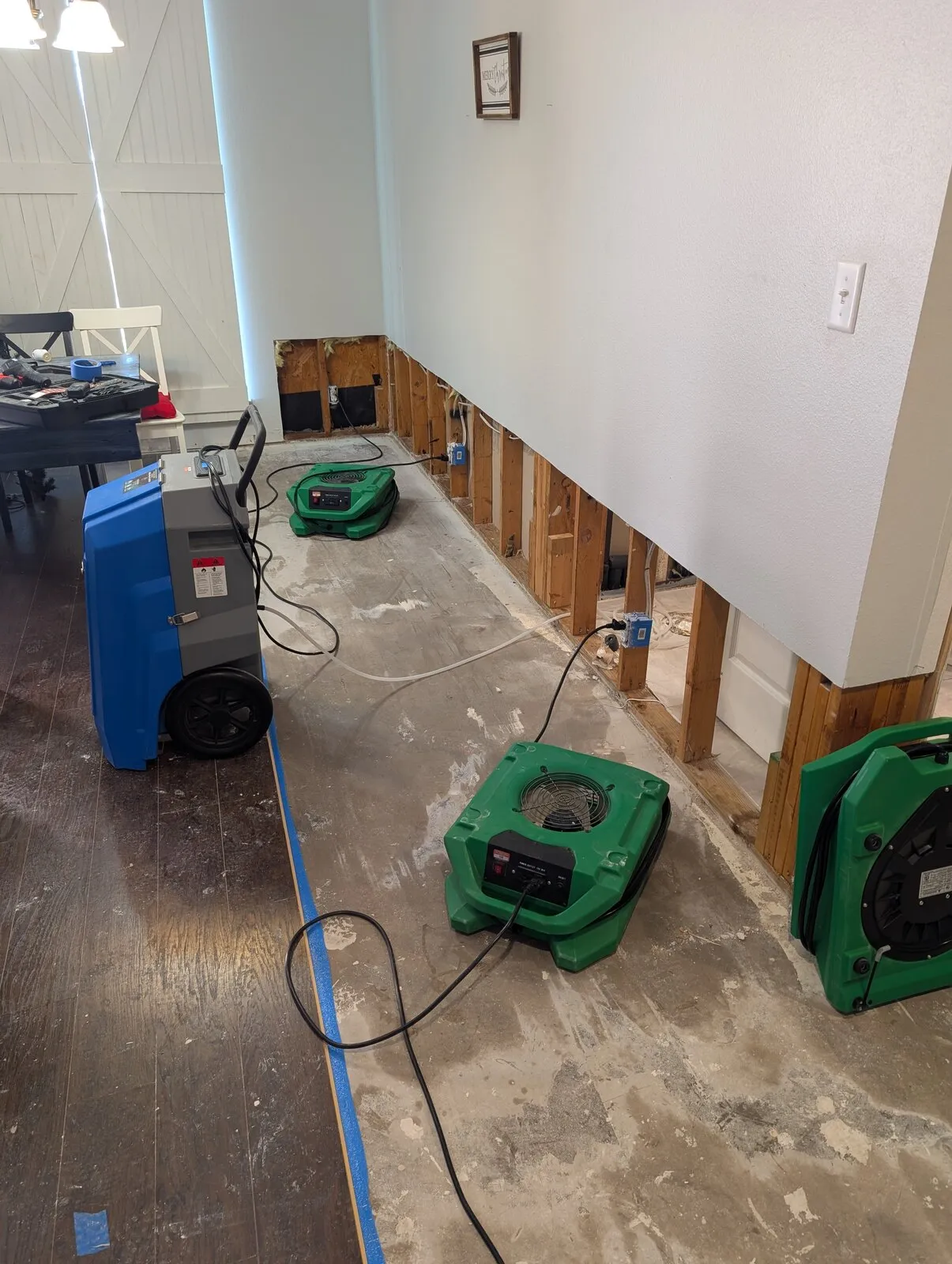
Industrial dehumidifiers and high-velocity air movers dry framing, subfloor and finishes where they stand. The number of machines and where they point is set by the meter readings, and reset by them as the readings come down.
Moisture Mapping
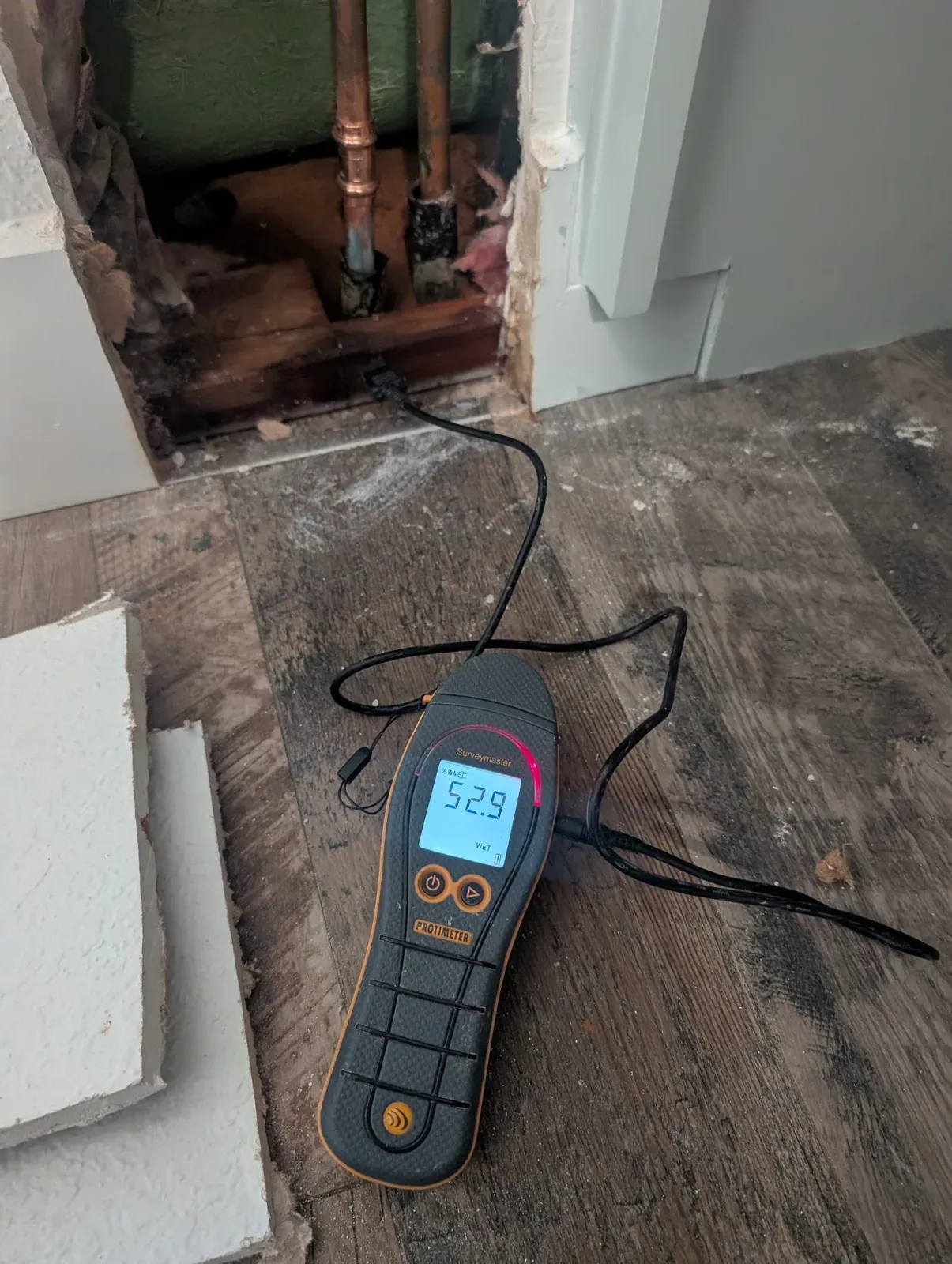
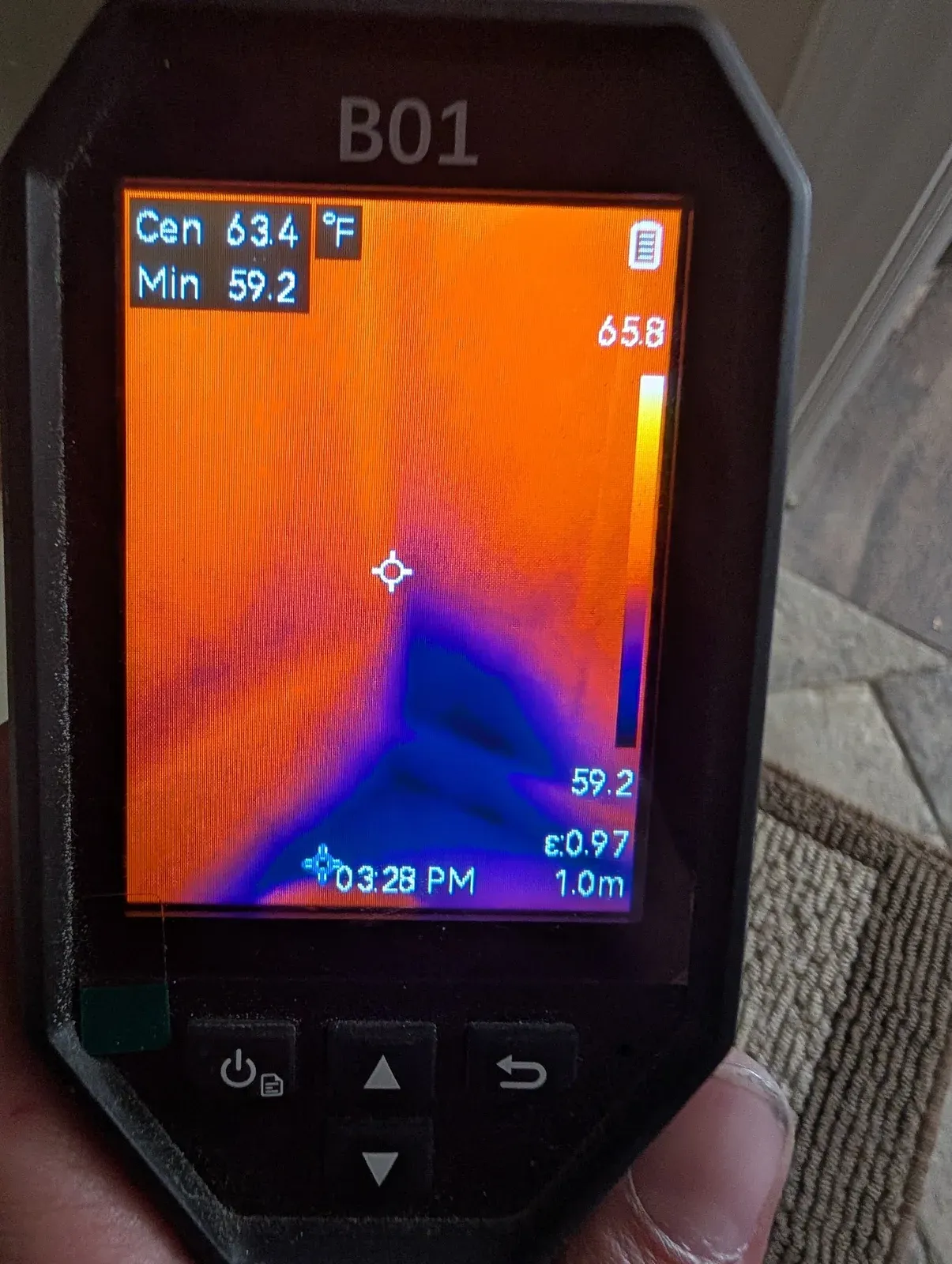
Before anything is opened up, thermal imaging and a calibrated meter mark the real edge of the wet area. On a slab floor plan that edge is usually under cabinets and into the next room, well past the part of the carpet that looks wet.
Wall-Cavity Drying
Injectidry panels move dry air through the inside of a wall, or under a floor, with the finish left in place. On an original-grid house that often means the base cabinets and the baseboard stay where they are.
Roof-Leak Water Repair
We tarp or board up the opening on the same visit, then work the inside: soaked insulation out, attic and wall cavities dried, ceiling and drywall repaired. Warrior Roofing, Justin's other company, does the exterior repair and replacement.
Mold Prevention
Mold takes hold where material stays wet past a certain point, so the prevention is getting it dry and proving that with a meter before anything has time to grow. Affected surfaces get an antimicrobial while the machines are still running. Where growth has already taken hold, the job is mold remediation and is scoped that way, and on a job that needs an independent licensed mold assessor, that assessor does the testing and writes the clearance.
Repairs & Reconstruction
Hanging board, taping, floating and texturing, then trim, paint and floor covering. A 1970s ceiling texture and a 2015 one aren't matched the same way, and both stay with the people who dried the house.
How We Work
Inside a Water Damage Restoration Project
Six steps, run in this order every time. Nothing gets closed back up until the materials read dry, so the middle of the job is the part that stretches.
Emergency Assessment
We work out where the water is getting in and how far it has already gone. Closing a valve that's still feeding it is ours; fixing the pipe or fitting that let go is a plumber's. Then the house itself gets read, meter by meter, with thermal imaging over everywhere the water could have reached. A written scope and estimate come with it, at no cost.
Water Extraction
The standing water comes up first, lifted off the floor with portable units. Carpet pad, insulation and anything airflow can't dry in place are bagged and carried out on the same pass.
Structural Drying
Air movers and dehumidifiers get set for what the room is made of, not for its square footage. Where it's the inside of a wall holding the water, Injectidry panels dry the cavity with the board left on. Generators cover the addresses where the power is out.
Moisture Monitoring
We come back to read the same marked points until they hold at a dry standard taken from an unaffected part of the same house. Those numbers are what move equipment and release the rebuild. A date on the calendar isn't.
Repairs Begin
Insulation goes back in, board gets hung, the flooring substrate is replaced, and none of it starts until the readings hold. Damage the drying uncovers after that first approval is filed as a supplement with your carrier before that work starts.
Final Reconstruction
Texture matched to what's beside it, then paint, trim and the floor covering go on. That's the room finished.
Insurance Claims
We Handle Your Insurance Claim from Start to Finish
The carrier side of a water loss is ours to run. The scope is written in Estimate Rocket, and line items that come in short of what the repair takes go back to the adjuster. Where a public adjuster is already working the claim, we work alongside them. Warrior Restoration is a restoration contractor, not a public adjuster: what's covered is your carrier's decision.
- We bill your insurance carrier directly. We coordinate with your carrier's adjuster and submit the complete scope of damage.
- We meet adjusters on site. We walk the property with the adjuster so hidden moisture gets documented before approval, not discovered afterward.
- We file supplements. If drying uncovers damage the original approval didn't cover, we file supplements straight with your carrier.
- You never owe us anything beyond the deductible. We accept the carrier's approved amount minus your deductible as payment in full.
- We handle mortgage company checks. If your lender's name is on the insurance check, we coordinate directly with them to get funds released.
Free On-Site Estimates
We inspect at no charge and provide a complete damage assessment before any work begins.
Call (903) 993-5663Workmanship Follow-Through
If our tile or flooring installation causes an issue, we return to fix it.
Water Damage in The Colony
The Decade Your House Went Up Decides What Failed
The Colony was built out of open prairie by one developer and has never stopped building. Fox and Jacobs, Inc. bought roughly 3,000 acres of Denton County ground, the first families moved into new single-family homes in the autumn of 1974, and subdivisions have been added ever since. The 1980 Census counted 11,586 people here; the 2020 Census counted 44,534. Each of those waves carried the plumbing and the framing standards of its own decade, which is why two houses a few streets apart can be thirty years apart in what sits behind the drywall.
In the original grid, the 1974 through 1980s houses, the parts nearest the end of their service life are the supply lines and the original slab plumbing. Copper of that age gives out at pinholes. Early polybutylene gives out at the fittings, and it is one of the things that can turn up once a wall is open; what's actually in your wall is what the opened wall shows. Water off either of them starts low and runs flat, so the first readings we take are at the slab perimeter and the cabinet toe-kicks.
The 2000s and 2010s subdivisions and The Tribute are a different build entirely. Nothing in them has aged out yet, so when water shows up it's usually a fixture, an appliance connection or a fitting rather than a line that reached the end of its life. That moves the search: we start at the connection and work outward with the meter and the camera, instead of reading the slab first.
The 2020 Census counted 18,814 housing units here at a 5.7% vacancy rate, and owner-occupancy was 59.8% in 2024, down from 61.8% the year before. So on a good share of these calls the person standing in the water rents the house, and the authorisation for the work has to come from the owner or the property manager. Tell us who holds the policy when you call.
Call (903) 993-5663Equipment We Use for Water Jobs
- Portable water extraction units: remove standing water from floors and carpet
- Industrial dehumidifiers and high-velocity air movers: dry structural materials to certified standards
- Injectidry wall-cavity panels: dry behind drywall and under floors in place
- Negative-air machines: control airflow when a water loss needs a drying chamber
- Calibrated moisture meters: verify materials reach certified dry standards
- Thermal imaging cameras: find hidden water inside walls and ceilings
- HEPA vacuums: safe cleanup of debris and contaminated materials
- Generators: maintain power for drying equipment on site
More Restoration Services
We Restore Homes Across Denton County
Two things sort these: who can authorise the work, and which address the water is at.
Residential Water Damage Restoration
If the wet house is a single-family home you own and live in, that's the version of this work written for it.
Learn MoreWater Damage Restoration in Aubrey
If the house taking on water carries an Aubrey address instead of this one, a relative's place included, that's the one to open.
Learn MoreWater Damage Restoration in Lewisville
If you look after a second address and that one is in Lewisville, it's covered the same way.
Learn MoreSTILL GOT QUESTIONS?
Frequently Asked Questions
What homeowners here ask most on a water call. For anything else, (903) 993-5663 is answered around the clock.
24/7 Emergency Response
Get Immediate Water Damage Restoration in The Colony, TX